This is more of an heretical sermon on the novel than anything else! Beware of spoilers for the entire book. This essay starts off as a review of Priest, discusses an historical example of sexuality and salvation in Augustine’s confessions, contrasts that with the idea of sex as spiritual transcendence in the novel (along with a lot of rather graphic recapitulations of its sexual acts), and finishes with a personal meditation on the intellectual and not-so intellectual experiences of faith, concluding with a TV show recommendation.
During one of the first few scenes of Sierra Simone’s delightfully explicit novel Priest, our titular hero walks into his office to jerk off to the confession he has just heard from the mouth of Poppy Danforth.
She is a lithe, slight-breasted heroine with dark hair and red lips. Her slightly oversized front teeth bite down enticingly on that sinful corner of her flesh in a way that drives him wild. Father Tyler is attracted to his newest confessor even before he sees her. Her voice, telling him her darkest sexual secrets in the enclosed silence of the confession booth, fills him with want.
Poppy, as we will later discover, is not sure what she’s doing in the church at all, but whispering her sins to Father Bell is not solely about satisfying her conscience. Within a few visits she has confessed that she is a sexually craven, Ivy-League-educated, heteronormatively beautiful rich white woman: also, she would like nothing more than for Father Bell to punish her for her sins like the very bad girl she is. Poppy, it turns out, has thrown away her predicted future of business-savvy Stepford-Wifeness to volunteer for humanitarian relief efforts in Haiti. She also works as an exotic dancer in an expensive strip club for fun, since she doesn’t need the money. She’s kind of Mother Theresa (before we really knew who Mother Teresa was) and the Whore of Babylon at the same time.
She tells Father Bell why she was attracted to exotic dancing in graphic detail: how powerful it made her feel to be desired, how men used her for sex and how much of a turn-on it was to feel degraded, commanded and objectified. She tells him her married ex found her in that club one night, fucked her like a whore and told her he must make her his. It was incredibly hot, and – worst of all – she doesn’t even feel like it was that sinful, even though she knows it was.
At the desires awakened in him at her words, Father Bell cannot do anything else but give into his lust. After she leaves his confessional booth he goes into his office and unzips his slacks.[i] He unsheathes his generously-sized cock and wanks off over his liturgical calendar, coming to his senses with a profound realization of shame as he splatters semen all over the church schedule.
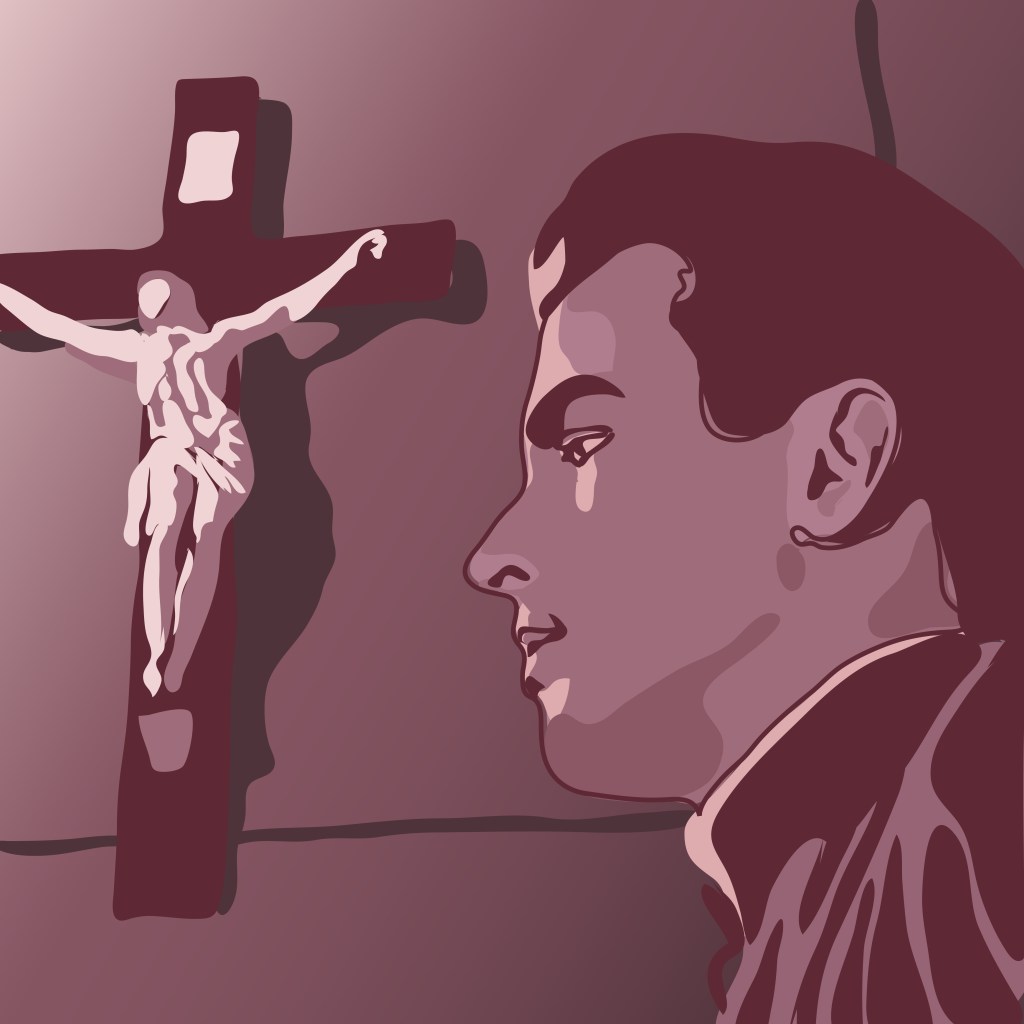
“Don’t pretend you don’t know what it’s like,” he mutters to Saint Augustine, who stares down at him with imagined condemnation in his eyes. Oh goody, I thought as I read this, downright gleeful at the thought of a mini Augustine’s Confessions infodump where we learn about his lovechild and his mistress. (It’s not that I didn’t love the wild desperation of this jerk-off-session – I just love nerding out about church history’s appearance in genre fiction nearly as much.) Augustine did know exactly what it’s like to suffer in that way. But from then on, Augustine is nothing more than a reproachful image on the wall, supposedly judging Father Bell as he looks down on him.
Since Sierra Simone did not go there, I will. Augustine, in his Confessions, a 4th Century CE meditation on the meaning and experience of conversion, confesses that he knows this kind of sexual sin intimately. He could not control his sexual appetite when he was a teenager, and his parents did not rein him in, saying the 4th C version of, “boys will be boys, just keep going with your studies, Augustine, and so as long as you don’t marry the wrong woman, you are going to be just fine!” This happens even though his mother Monica, the most important character in his personal story of conversion, was extremely religious and did not condone what he did. She told him to be chaste, but if he could not be, she made him promise to not sleep with anyone married at least. He writes that his father celebrated the loss of his virginity by getting drunk and cared more for his education than his soul.
When Augustine was still a teenager, he took a woman as his mistress whom he loved at first, but later grew to loathe. With her, he had a son whom he loved very much, a bright boy who died tragically while still young. Eventually Augustine abandoned his mistress because he’s kind of an asshole: a stunningly intelligent man deeply introspective about everything in his life except the fact that he used this woman entirely for sex and never married her. Infuriatingly, he does not respect her enough to even name her in his Confessions, though he names pretty much every friend, scholar, priest and deluded Manichean he encounters in the rest of his fucking life. He does not even account for his wrongs to her by using her as he did. His sin, according to himself, consisted of lusting after an inferior, uneducated woman like her, with whom he could have no intellectual communion, and believing that to be love. In his mind, having sex with her degraded him and deterred him from his path towards righteousness. If there was going to be a contrapuntal figure to the man Father Bell strives to be in this book, it could very well be Augustine. Their temptations and eventual absolution are both similar and opposed. For Augustine, sex is not a source of divine revelation; for Father Bell, it very much is. But both of them have ecstatic religious experiences with women that transcend normal human experience. Augustine shares a holy vision with his mother after his conversion, meditating on the stars to understand the nature of eternity. Father Bell is seduced into leaving the priesthood because of his desire for Poppy, after he is so changed by sex with her that he understands the whole world differently.
Asshole that he can be, some of the sentiments Augustine writes in his confessions are eminently relatable. He was a self-described lazy student in his youth who had to be forced to study; as an adult he hated his job as a teacher because his students would scam him out of tuition, and he found many of his colleagues to be superficial dilettantes obsessed with style and status of a text rather than its meaning. Augustine is also very frank about his sex life in his confessions. What he wrote could have been written by any of us who’ve enjoyed sex of questionable Judeo-Christian morality and gone to church afterwards. Literally as he’s undergoing his conversion experience, Augustine waffles over how difficult this will be, particularly how he can’t have sex anymore. He talks about his wet dreams (or so I infer) after he’s committed to celibacy: “But in my memory of which I have spoken at length, there still live images of acts which were fixed there by my sexual habit. These images attack me. While I am awake they have no force, but in sleep they not only arouse pleasure but even elicit consent, and are very like the actual act. The illusory image within the soul has such force upon my flesh that false dreams have an effect on me when asleep, which the reality could not have when I am awake.” (Book X) Augustine is also DTF with some bondage metaphors. Before his conversion, he was jealous, lustful, and possessive over one of his mistresses: “My love was returned and in secret I attained the joy that enchains. I was glad to be in bondage, tied with troublesome chains, with the result that I was flogged with the red-hot iron rods of jealousy, suspicion, fear, anger, and contention.” (Book III)
Tyler Bell is a priest with a fraught past, not unlike Augustine’s. It involved kinky sex, his domination of women, his love of bossing them around to get them off, as well as a genuine and deep respect for them as persons. (Unless your name is Monica and you are willing to join him on a holy vision in which your soul leaves your body through meditation, respecting the personhood of women is admittedly not something Augustine would ever be into.) Tyler, like Augustine, has made the decision set aside all sexuality to be a priest, tried to contain and lock-up his own desires. The book gives him a “dead sister molested by a priest” motivation, in which he seeks to personally atone for her suffering by being a good and moral priest – a counterbalance to the abusive man whose harm towards his sister would eventually drive her take her life. I did not find the emotional payoff of this plot to be that great, but perhaps it was because I wanted more theological agony than personal grief.
Poppy comes into Father Bell’s church and unlocks those sexual desires he has stifled, opening a Pandora’s box of his lust. In an improbably short period of time since their acquaintance commences, he spanks her, fingers her, ties her up with consecrated ropes, and anoints her asshole with holy oil before he fucks her anally. I do wish there was a tiny bit more of a slow-burn before he’s discovering she wore no underwear to confession, then bending her over the church piano and fingerbanging her. But this is a book entirely enthusiastic about sex and lust, while also separating lust from romantic love as two related but distinct experiences, so I can understand this choice.
Almost every single sexual act the pair perform takes place in the church or in the rectory. True to form, they fuck each other in a prayer room only divided from the sanctuary by a screen wall, minutes before walking down the aisle at the novel’s conclusion. Midway through the book, they have passionate sex on top of the church altar in an act that Tyler meditates seems as holy as it is profane, Poppy laid out like a human sacrifice for him to take as though he stands in the possessive yet loving role of God himself. The earlier sex is over-the-top with notes of BDSM, while sex in the middle-act becomes increasingly tender before it veers back into the territory of sadomasochistic punishment. Early in the book, Tyler engages in outrageous, not-quite-sex equivocations, like stimulating himself by rubbing his dick along Poppy’s vulva without penetrating her (as she’s spread-eagle on the floor of the church sanctuary, naturally); on another occasion entering her not-quite-all-the-way and not thrusting in her so it “won’t count.” Afterwards he realizes that, hot damn, it definitely did.
While it’s not as though a book in which the priest calls his love interest “little lamb” as he spanks her in the sanctuary takes itself entirely seriously, neither is it a dumb, campy, giggle-fest. The sex is beautifully written, the author handling this decadent, hyperbolic and kinky material with sensitivity and nuance, no matter how outrageous some of her scenarios are. Another reader here called it “elegant,” and I agree – this is some of the most well-crafted smut in existence. Not only is the style superlative, but the sex is a revelation – masochistic and sensitive at the same time. I don’t even like BDSM that much, but here, Tyler’s domming is clearly calculated to get his partner off rather than a purely selfish action. He is attuned to her desires, he reads her well, and in scenes where consent is tricky to establish, he dips out of dominance long enough to make sure she’s as into it as he is with explicit verbal consent. It seems clear they do not use safe words because they do not lie to each other about what they are experiencing or play with non-consent. Many actions are spoken expressly to drive the other person wild before they are committed. I deeply enjoyed that aspect of their dynamic, which is an indication of the author’s talent, that she can make us see why something we don’t really like can be seductive to others, how we might feel if we were into that (or perhaps we are a little into that and we never realized it). And Poppy might love being submissive when she has sex, but she never comes across as weak in any other sense.
Tyler inhabits the persona of a priest to profane it romantically by fucking his secret girlfriend really well, often immediately after her confessions. It’s impossible to separate the priestly aspect of who he is from the carnality of who he is, nor her desire for him as a man from her lust for him as her spiritual leader. Simone also understands that wallowing in guilt over sexual regret, thinking “I shouldn’t have done that,” would make for a rather shallow understanding of sexual morality, and she does not do so here. Her thesis seems to be that sex itself is always sacred, while the context that makes it profane is a theological question, much of it depending on what is in one’s heart. The author says as much when Tyler falls in love with Poppy, a realization he has as he fucks her. When he anoints her ass with holy oil, he tells us he does so because, as one would anoint a building to consecrate it, he pours out the most precious things he has on the body of his beloved, as though she is the most sacred thing he could ever imagine or want. It’s the 21st century version of Mary Magdalene pouring out her expensive perfume on Jesus’ feet and washing them with her hair. It’s because of his utter subjugation to love that Tyler would give up his most precious ideals for his beloved – his holy objects and his chastity.
The conflation of spiritual with carnal desire is not some modern invention. There is a reason that communion with the divine, in Baroque sculpture, is represented as orgasmic: check out the ecstasy of St. Teresa of Avila as carved by Bernini. From her own words in translation, Teresa’s ecstatic experience was not only intellectual: she specifies that it was bodily as well. In her vision, her heart was deeply “pierced” and “penetrated” by the spear of an angel, which enflamed her as he withdrew it: ”The pain was so sharp that it made me utter several moans; and so excessive was the sweetness caused me by this intense pain that one can never wish to lose it, nor will one’s soul be content with anything less than God. It is not bodily pain, but spiritual, though the body has a share in it-indeed, a great share.”
This book’s beauty is in the way it understands sex – even kinky, dominant-submissive sex which profanes sacred things – as still deeply spiritual. If the body has a great deal to do with spiritual transcendence, we can easily imagine that spiritual transcendence might reciprocally begin with bodily pleasure. But the other thing I wanted from this book is a priest character who is as in love with faith as he is with sex. And this is not that book. Father Bell the Priest, as a character, is a Totally Normal Guy who would not be googling St. Teresa’s O-face for fun on a weeknight.
I think this was a conscious decision of the author’s, to make Father Bell someone for whom being a priest is other than this lifelong calling so it’s understandable that he eventually leaves. However, it makes his engagement with his profession seem a little shallow. In his spare time, he visits his family, bickers with his siblings, goes on Reddit to argue about The Walking Dead, orders pizza for the youth group, and works on his panel material about sexual immorality in the priesthood with only a twinge of compunction. He might love being a priest, but he loves it in the same way as any character loves their desk-job: because he is good at it, because people like him at his job, because it gives him some sense of purpose. Tyler experiences almost no intellectual agony over what he continues to do with Poppy either. His idea of self-penitence is physical, going on long runs and distracting himself with work. Intellectually, he does not excuse what he has done after it happens or pretend it is fine that he has done this. The choice is simple. He will either give her up at some point (which he vows to do but doesn’t want to do in actuality) because of his flock who need him and his dead sister’s memory. Or he will give up being a priest.
We don’t see how being a priest satisfies him in a more spiritually profound sense: how his talent for seduction might be channeled into an effective homily, sparkling with wit, opening the words of the text to a congregation who would otherwise be bored with it or find it inscrutable. We don’t see Simone’s Father Bell in love with the text of the Bible, thinking of its stories and wisdom (and also laughing at its fucked-up-ness) in the course of daily life. We don’t see him in awe of the deep sacredness of the traditions he upholds, or the holiness of the experience of performing his priestly role. The Father Bell I wanted to read is a St. Paul stan getting into a Reddit argument over whether Paul is a “disorganized” writer in his epistolary works on AcademicBiblical. (Sadly, I get the sense that this guy is more of a James adherent with his insistence on good works of the white savior variety). My imaginary Father Bell is explaining to Poppy why the Song of Solomon is still erotic today as a reading experience, long-after we’ve stopped comparing women’s teeth to sheep and their breasts to palm nuts. He is defending how he can be part of an institution that has done so much harm, things that absolutely cannot be justified: it has wiped out the native religions of entire cultures, abused people, invoked wars, subjugated women, and too-often failed to provide the spiritual guidance people need in modernity, ignoring the suffering of real people who don’t fit neatly into its narrative of human experience. Imaginary Father Bell is a lover of the flawed and broken church as much as he is a lover of one flawed and broken woman, and he would have truly had to choose between those equally romantic and inspired loves at the novel’s conclusion, beyond whatever “super-rich BDSM boyfriend” competition he might have with another guy over Poppy.[ii]
I wanted a love-letter to faith from someone grown disenchanted with it, who still found things to love within it. I once found meaning and purpose within religious faith myself, but can no longer find those things there. I was brought-up in a small sect of the Protestant tradition where I came to know faith as something intellectual, about interpreting the Bible’s text and trying to live in accordance with it, a task that seemed nearly impossible, because it did not relate all that easily to life in the modern world. My faith became a tangled thorn-bush of guilt, self-undermining, shame and penitence. I delighted in the ancient stories I read in the Bible, whose logic was baffling, where god moved among humans and where miracles were performed, but that was disconnected with faith’s meaning for me personally, which was primarily an experience of suffering. When faith moved me emotionally it was through negative feelings: I constantly perceived myself as broken, less-than perfect, an inevitable sinner no matter how I strived towards uprightness. It had layers of paradox I could not untangle, a sense that even if I turned into a literal crusader for religion – an idea I was always extremely uncomfortable with – it would still not be enough.
Then, while still a teenager, I attended an Orthodox funeral for a distant relative. The priest chanted in Latin for what seemed like hours: later, he would tell me he was praying for the souls of the dead, a completely nonsensical idea to my evangelical ears. The small country church, which my long-ago ancestors had helped to build, was filled with incense until the air was thick with its perfume. The priest paced in front of the apse, the censer’s hypnotic sway seeming to touch every corner of the room. As he chanted words I didn’t understand until they became a song, light from the windows illuminating the embroidery on his stole, I was changed. It was one of the most moving, powerful religious experiences of my life. I understood in that moment that my senses, attuned through ritual, were as much a part of faith as my mind – perhaps they understood more instinctively than what my mind could ever know.
I did not leave religion for many years after that. I never seriously considered becoming Orthodox, because I could explain things in the faith I had known with words, and this was beyond words entirely; it could not be intellectualized. This was an experience in which I fully understood how one might sit forever with gnostic paradoxes and be untroubled by them. It was a feeling of pure joy simultaneously painful enough to move me to tears, and nothing – not knowing how awful Orthodoxy is for women’s rights in the church, not even leaving the faith – could diminish this memory of what was, at its essence, a holy and transformative experience.
And this is what the older sects of Christianity have to offer that I wish could be detached from all the things that make them impossible to believe in for some of us: religious mystery that transcends understanding, the depth of faith and tradition so far beyond an individual’s questions or faults that they melt away into almost meaninglessness before the soothing balm of ritual. Sex itself is bound up in that mystic holiness of performative ritual, insofar as it touches the body as well as moves the soul, as it transcends individual experience to unite us in communion with something greater than ourselves. Faith might involve the intellectual desire to pursue knowledge of what is spiritual, but full knowledge – of a lover or a religion – is ultimately a bodily experience as well. While it is true that Augustine did not consider sex spiritually transcendent, his conversion involves a physical experience that, not unlike sex, leaves him shaking and breathless. He literally calls this experience “the birthpangs of [his] conversion.” He weeps in agony with the intensity and sweetness of his closeness to divinity.
While I might have wished for a romance-novel version of John Updike’s A Month of Sundays, in which a very bad priest plays theological mind-games with the reader while epistolarily confessing to depraved sexual sins, I must confess that I still absolutely loved Priest, despite wanting it to be something beyond what it was. Also, I would wager that Phoebe Waller-Bridge, creator of the amazing show Fleabag, has definitely read this book, as a similar plot figures in the second season. Fleabag’s peter-pan collar as she sits in the confessional booth, and her priest’s command, as she steps outside the booth, to get “on your knees,” are either knowing winks to us readers of this book, or perhaps inevitable devices in a story about a priest falling in love with a woman. Fleabag’s priest character speaks beautifully of what it means to experience holy love; to wonder if one is falling in love with a person or truly desiring the glimpse of divine love they encounter in them, this human experience of love only a visible fragment of God’s great love for us. If you believe in that sort of thing. Fleabag doesn’t, but that vision of love is so seductive, almost as much so as the beautiful priest who understands what she wants in a way no one else does, that she is tempted. If you liked this book, I think you’ll love that show. You might like it so much that you – like me – will seek out other stories of priests falling in love, out of nostalgia for this encounter, or because of your nostalgia for something else you’ve set aside and locked away, impossible to pursue as a lover who left you heartbroken – religion itself.
Don’t worry over your desires for either of those things. It’ll pass.
This essay was previously published on Reddit. You can find the post and ensuing discussion here.
[i] There is no less erotic word in the English language for dress pants, and the author uses the word “slacks,” by my last count, approximately ten thousand times, which is literally the only thing about this book’s writing style that I did not adore.
[ii] I didn’t hate that plot. While I hate “I manipulated you into thinking I didn’t love you for your own good,” plots and I hate lies of omission, I loved Tyler’s eventual meeting with Sterling, which undermined the usual male pissing contest trope. I also enjoyed that neither of them “won” over the other in an immediate sense because of Poppy’s actions.

 Bittersweet Read
Leave a comment