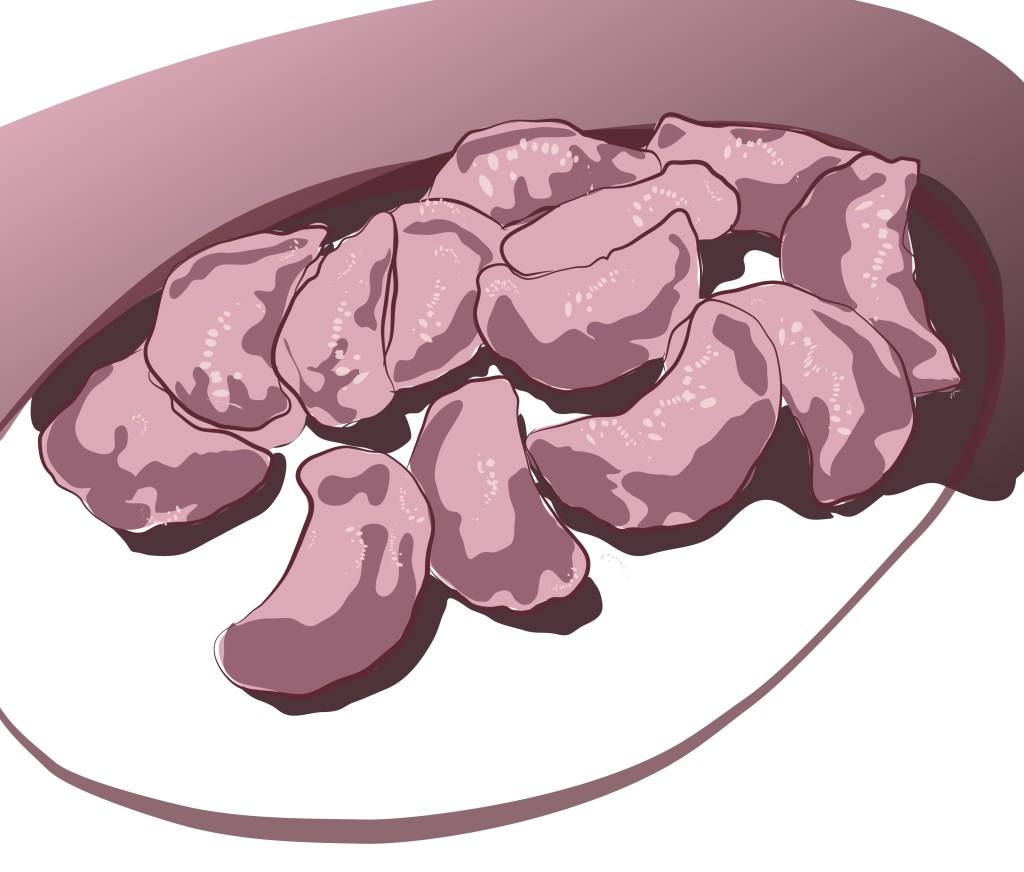
Introductory note: So many thanks to Alexis Hall for asking for my family’s pierogi recipe to be included at the end of the novella Chasing the Light, Part II of Waiting for the Flood! WFTF is one of my fave AJH books ever, I was honoured to contribute to it in this small way, and I’m beyond thrilled people might attempt pierogi-making after reading it. Do feel free to reach out if you want feedback on the pierogi-making part of things: I’d be delighted to help you out.
The review of Waiting for the Flood below was originally published on GR three years ago: I’ll append this post at some point to review Chasing the Light, which at this point I don’t have analytical thoughts over, so much as a lot of emotions about.
***
There are so many subtle themes about collective good and individual acts of kindness in this story, which reconciles two men with vastly different attitudes about how to care for things and people through acts of love.
Edwin is solitary, and only two elders seem to understand him; his octogenarian neighbour, dispensing no-bullshit life advice; and his ex’s mother, who frequently calls and texts him. Outside of his job in the Bodelian archives, he spends his spare hours restoring ephemera he finds in bookshops. This expenditure of his time and effort is less about a personal investment in the subjects of the historical texts he salvages, and more about exhibiting care for what would otherwise be discarded as worthless. His mentality is relentlessly retrospective: ruminating on the void in his heart left by his ex, a painter who seduced him and then left the canvas reminder of the Edwin who once was in the attic. Unlike Dorian Grey, the portrait does not preserve him forever in youthful beauty, but prevents him from moving on by showing him as he once was loved, and, he fears, won’t ever be again. And, as an archivist, of course he can’t ever destroy it a la the final act of the Portrait of Dorian Grey – that would be antithetical to his nature.
Enter Adam, the cheerfully kind flood management strategist sent to Oxford to save individual houses with sandbags and as much real-estate as possible with strategy. His introductory dialogue consists of an explanation of why everyone using their flood cellar as a basement storage overflow is a collectively bad idea. He flirts with – or gets closer to – Edwin – via an extended discussion of how individual vs collective needs are balanced with game theory rationales, illustrated with an example involving teaspoon hoarding in an office environment. It’s not that people are intrinsically bad or selfish, he opines. it’s just that they have to be prompted to think of others; to be better. His crew, laughing at how he chastises a truck driver for splashing through a puddle and soaking pedestrians – Edwin, in this case – call him the “arsehole whisperer.” He relentlessly looks for the good in others, and he often finds it.
This is not a book about big shows of emotion, grand gestures or chasing after your crush through the floodwaters the night before he leaves town. This is a story that constructs romance quite purposely out of banality, out of thoughtful acts like giving a man your third pair of rain boots because the only thing he has to brave the flood are leaky, sparkly cowboy boots. In return, Edwin feeds Adam homemade bread, tea and lets him ogle his bookshelf. Adam just accepts him wholly in his stammering and awkwardness, and expresses delight at being invited into this reclusive man’s sacred trust, and all that cozy domesticity – even with floodwaters encroaching – is as romantic as anything I’ve ever read. Adam might be extroverted and analytical; Edwin introverted and sentimental, but in each other they find a sympathetic understanding through conversation that seems rare and special. (Their two favourite jokes, Adam’s hyper-logical and nerdy, Edwin’s just completely nonsensical and subversive, are as perfect a statement of character as anything I’ve ever read.)
What I like best, maybe, is the subtle idea of a “procreative” coupling that is not so much about children (though Edwin does say he dreams of being a grandfather) as future hopefulness. Both Edwin and Adam are, after all, engaged in acts of saving old things: Edwin, Oxford’s ephemera, Adam, the architecture of the entire town. But remembering isn’t only about remaining mired in the past – it’s about keeping things alive. Edwin’s Ex’s mother, in a phone conversation late in the book, brings up the fact that Edwin was always the one to remember anniversaries and birthdays, to let his ex’s family know how valued they were. Adam’s task is not only to act to save buildings, but to rally his crew around the idea of the good they can collectively enact so the historic place can be preserved for the future. Adam tells Edwin not to worry that he won’t be exciting anymore when he’s less unknown to Adam at some future point, because, even if he won’t be mysterious, “you’ll be you, and that’ll be better.” Memory, as intrinsically linked to who we are and what we value, is the very thing that enables creation of a shared future.
Originally published on Goodreads on Nov 5, 2020
 Bittersweet Read
Leave a comment